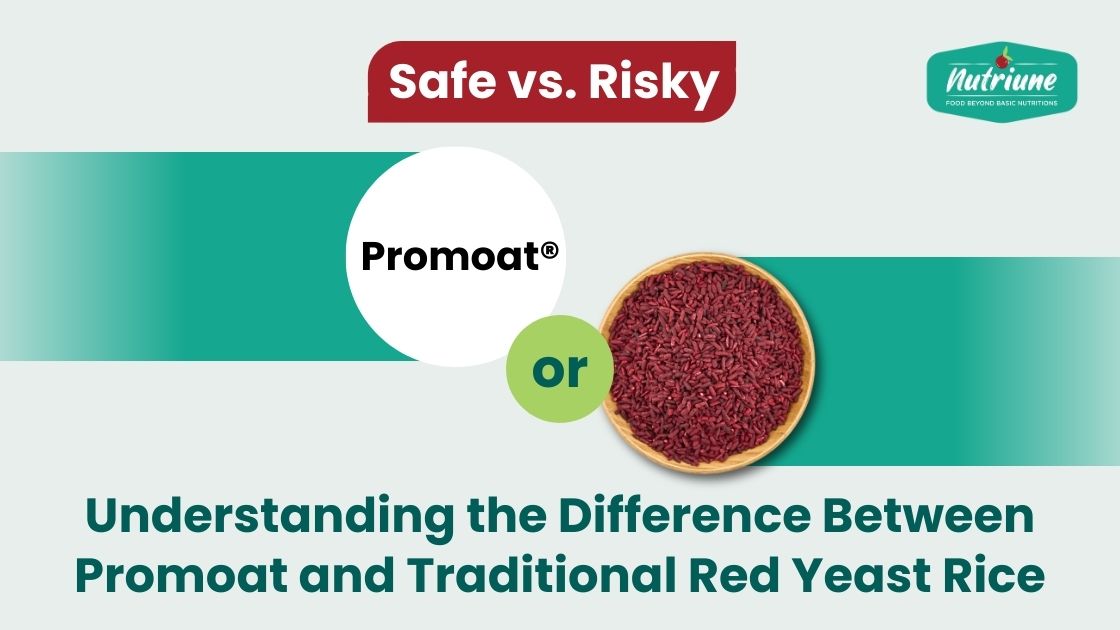
You have recently been told your cholesterol levels are creeping up, you have likely fallen down the rabbit hole of internet research. You want to avoid the side effects of pharmaceuticals, so you look for natural alternatives. Inevitably, you stumble across two major contenders: The "Rice thingy" (Red Yeast Rice) and Oat Beta-Glucan.
On the surface, both promise to help manage cholesterol. But when you peel back the label, the mechanism and the safety profile couldn't be more different. One works by mimicking drugs; the other works by harnessing the natural power of food science.
At Nutriune, we chose Promoat for a reason. Here is the deep dive into why your choice of supplement matters for your long-term health.
Red Yeast Rice vs Oat Beta-Glucan: What’s the Difference?
The "Rice Thingy": What is Red Yeast Rice?
Red Yeast Rice isn't just "rice." It contains a compound called Monacolin K, which is chemically identical to the active ingredient in prescription Lovastatin. While it is natural, it functions exactly like a low-dose drug in your body.
Red Yeast Rice (RYR) is a traditional Chinese culinary and medicinal product made by fermenting rice with a specific type of mold (Monascus purpureus). It has gained massive popularity in Singapore and globally as a "natural" way to lower cholesterol.
However, its "natural" label can be misleading. During fermentation, the mold produces a substance called Monacolin K. If you were to analyze Monacolin K in a lab, you would find it is structurally identical to Lovastatin, the very first statin drug created by pharmaceutical companies.
This means that when you take Red Yeast Rice, you aren't just eating a grain; you are essentially taking a biological version of a statin. It inhibits the enzyme in your liver that produces cholesterol. While effective, this mechanism of action brings us to the critical issue of risk.
The Hidden Risks: Why "Natural" Doesn't Always Mean Safe
Because it acts like a statin, Red Yeast Rice carries statin-like risks. These include potential liver stress and muscle pain (myopathy). Furthermore, poorly manufactured RYR can be contaminated with Citrinin, a toxin that can damage the kidneys.
The "Risky" side of the equation lies in the side effects. Because Red Yeast Rice operates on the same biological pathway as statin drugs, users can experience the same "Statin Side Effects" that many of our customers are trying to avoid.
- Muscle Issues: Users may experience muscle pain, weakness, or cramping.
- Liver Impact: Just like prescription statins, high doses of Monacolin K can stress the liver.
- The Citrinin Problem: This is a major concern with unregulated supplements. Citrinin is a toxic byproduct of the fermentation process. If the manufacturing process isn't strictly controlled, your "heart-healthy" supplement could inadvertently contain kidney-damaging toxins.
This inconsistency is why many doctors are hesitant to recommend Red Yeast Rice you never quite know exactly how much "drug" (Monacolin K) or toxin (Citrinin) is in every capsule.
Enter Promoat: The Swedish Safety Standard
Promoat is completely drug-free. Unlike Red Yeast Rice, it does not mess with your liver enzymes. Instead, it uses a physical mechanism, forming a gel in the gut to trap cholesterol and remove it naturally. It is the safe, non-radiated choice.
This is where Nutriune draws the line. We utilize Promoat, a premium Oat Beta-Glucan imported directly from Sweden. Promoat is not a drug mimic; it is a bioactive fiber. Here is why it is the superior "Safe" option:
- Physical vs. Chemical: While Red Yeast Rice chemically inhibits your liver, Promoat works physically. When you consume it (like in our Nutriune sachets), it mixes with water in your digestive tract to form a thick, viscous gel. This gel binds to bile acids (which are made of cholesterol) and escorts them out of your body naturally.
- No Statin Side Effects: Because it doesn't enter the bloodstream to inhibit liver enzymes, Promoat does not cause muscle pain or liver toxicity. It is safe for long-term use.
- Purity Guaranteed: Our Promoat is derived from Swedish oats and is processed without the use of chemicals or gamma radiation. This appeals directly to the "Clean Label" shopper who values ingredient transparency.
The Clinical Verdict: 40 Years of Evidence
Authority you can trust. Oat Beta-Glucan isn't a fad. It is backed by over 40 years of clinical research and holds approved health claims from both the FDA (USA) and EFSA (Europe) confirming it lowers cholesterol and reduces heart disease risk.
When it comes to your heart, you shouldn't rely on guesswork. The problem with many "Rice thingy" supplements is the lack of standardization, one batch might be strong, another weak.
Promoat, however, is backed by rigorous scientific data.
- The 3g Rule: Research consistently shows that consuming 3 grams of soluble oat beta-glucan daily is the "magic number" for reducing LDL cholesterol.
- Global Approval: This isn't just marketing fluff. The US Food and Drug Administration (FDA) and the European Food Safety Authority (EFSA) have authorized health claims for beta-glucan.
- Beyond Cholesterol: Unlike Red Yeast Rice, which is a one-trick pony, Promoat offers systemic benefits. It helps improve glucose management (blood sugar spikes) and enhances gut health by acting as a prebiotic.
Why Nutriune is the "Food Beyond Basic Nutrition"
Synergy matters. Nutriune combines Promoat with Inulin and Isomaltulose for a 4-in-1 health benefit. We position ourselves as a "Statin Alternative" that competes on value and safety, ensuring you don't have to trade your liver health for lower cholesterol.
At Nutriune, our mission is "Food Beyond Basic Nutrition". We understand that the "Statin-Averse Patient" is looking for peace of mind.
We didn't just stop at Oat Beta-Glucan. Our formula is a Synergistic Blend:
- Promoat: For Cholesterol reduction.
- Inulin: A prebiotic to support gut health and digestion.
- Isomaltulose: For steady energy and better blood sugar management.
By choosing Nutriune, you aren't just taking a supplement; you are adopting a scientifically validated lifestyle change. You avoid the "hidden drug" risks of Red Yeast Rice and embrace a solution that has been nourishing hearts safely for decades.
Why Long-Term Safety Matters More Than Short-Term Results
When choosing a cholesterol solution, many people focus only on how quickly results appear. However, cholesterol management is not a short-term goal. It is a long-term commitment that requires consistency and safety over time.
This is where the difference between Red Yeast Rice and Oat Beta-Glucan becomes even more important. While both may lower cholesterol, the long-term impact on your body is very different.
A solution that works with your body’s natural processes allows you to maintain results without adding additional stress to your system. Over time, this approach not only supports heart health but also improves overall metabolic balance.
Choosing a safer, sustainable option ensures that your health strategy remains effective not just for 30 days, but for years to come.
Conclusion: Make the Safe Choice Today
Managing high cholesterol is a marathon, not a sprint. You need a partner that supports your body, not one that stresses it.
While the "Rice thingy" might be popular, the risks of unregulated dosage and side effects make it a gamble. Nutriune with Promoat® offers you the clinical efficacy you need with the safety profile you deserve.
Ready to lower your cholesterol safely? Start your journey with our Hero Bundle (45-Day Supply).
Looking Ahead: A Smarter Way to Protect Your Heart
As more people become aware of the risks associated with traditional approaches, the shift toward safer, food-based solutions continues to grow.
Understanding how different options work allows you to make more informed decisions about your health. Instead of relying on trial and error, you can choose a path supported by both science and long-term safety.
Ultimately, the goal is not just to lower cholesterol, but to protect your body in a way that is sustainable, reliable, and aligned with your long-term wellbeing.
FAQs About Red Yeast Rice vs Oat Beta-Glucan
Q: Is red yeast rice safe for cholesterol?
Red yeast rice may help lower cholesterol, but it carries risks similar to statins, including potential muscle pain and liver stress, especially with long-term use.
Q: Why is oat beta-glucan considered safer?
Oat beta-glucan works through a physical process in the digestive system without interfering with liver enzymes, making it safer for consistent, long-term use.
Q: Does red yeast rice act like a statin?
Yes. It contains Monacolin K, which is chemically identical to lovastatin, meaning it functions similarly to a pharmaceutical drug.
Q: Can I take oat beta-glucan daily?
Yes. Oat beta-glucan is safe for daily consumption and is most effective when taken consistently.
Q: How long does it take to see cholesterol improvement?
With regular intake and consistent habits, improvements may begin to appear within a few weeks.
Q: Is oat beta-glucan better than supplements like red yeast rice?
It depends on your goal. Oat beta-glucan offers a safer, food-based approach, while red yeast rice behaves more like a drug.
Q: Do I need to avoid medication completely?
Not necessarily. It is best to consult a healthcare professional, but many people explore natural options before moving to medication.
Q: Why is consistency important in cholesterol management?
Cholesterol metabolism is continuous, so daily habits and consistent intake are key to maintaining results.